Exmouth to Karijini National Park
15 – 20 August
Ever since spending a year in Karratha, but not actually getting out of Karratha and seeing any of the rest of the Pilbara region, I was excited to go exploring. On the top of the list of places to go was Karijini National park, inland near Tom Price and the Iron Ore mines run by BHP, Rio Tinto and FMG.
Exmouth to Karijini National Park. Not a heck of a lot to tell you about this drive. It’s 714km long. Sealed most of the way, all of the way if you detour through Paraburdoo, which we did just so we could say we’d been to Paraburdoo. The scenery however is amazing. Much like you would expect from the deserts in Utah, the land is dry with mountains and hills which just feel like they are old. The recent rains however have left the trees and grasses green and a few patches of blue and purple wild flowers in bloom. The spinifex bushes in particular had gone to seed like there is no tomorrow. Arriving in Karijini we knew that there was no chance of any space in the camp ground, so headed straight to the free overflow for the night.
Karijini is most noted for its gorges. The rocks are sedimentary with layers of silica and iron rich sediments forming very hard and heavy rock under what used to be an inland sea. Cracks formed in this layer during tectonic movement and started the gorges we can explore today. The park has three systems of gorges open to the public, the most eastern of these is Dales Gorge, in the centre is a collection of gorges including Weano, Red, Joffre, Hancock & Knox Gorges, and in the north west is Hamersley Gorge.
Dales gorge is a nice family friendly gorge, about 2km long, quite wide, and had permanent water sources keeping the red gums, fig trees and paperbarks which cling to the cracks in the rocks. The permanent water sources also allow for permanent swimming holes. We walked along the bottom of the gorge starting at circular pool along to Fortescue falls and on to Fern pool, swimming at each of them. Circular pool was probably the coldest at about 16 degrees and was a nice introduction to swimming in the north west. The pool was deep and clear with water filtering out of the rocks on one side replenishing the pool. Once we got used to the temp it was hard to get Estelle out of the water. We walked through the red walls of the gorge, negotiating stepping stones over shallow pools and winding our way through trees. Even though there were hundreds of people in the area it still felt like there were not many people around.

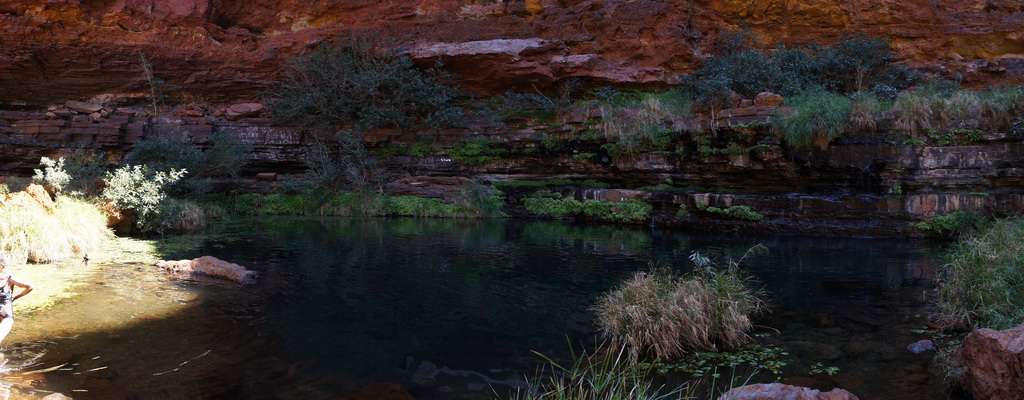


Fortescue pool below the falls was marginally warmer, but as it was more accessible, the water had been stirred up so wasn’t quite as clear. The falls cascade over the stepped rocks down one side of the gorge. A little further up the gorge is the quiet fern pool. It is a quiet secluded place with a small waterfall streaming off an overhanging rock ledge allowing visitors to sit up behind the falls. The site is an aboriginal sacred place, and it shows why. It was by far the most relaxing place in the gorge.
The walk back to our camp site took us along the rim of the gorge treating us with spectacular reds, greens, yellows and blues of the area with the afternoon sun behind us.
The gorges in the centre of the park are completely different however. Much more narrow and deeply cut to a depth of at least 100m, they are very impressive. Parts of them are open to the general public when the water levels are low enough, however they can be treacherous places to be meaning that sections of them are kept out of bounds to those who are not trained to deal with their unique hazards. One section which is open is Weano Gorge down to Handrail pool. It’s called Handrail pool because there is a handrail to help you down the waterfall to the edge of the pool. Following the gorge down to the pool, it gets narrower and narrower until it is less than a meter wide with perfectly smooth rocks on either side. A small stream flows in the bottom of the gorge until it falls down a smooth slope into the pool below. Donning your togs you can follow the water past the pool by swimming along another section of gorge to the rocks at the end where a sign stops you from going any further. The section past the main pool is amazing as it is quite undercut, only allowing limited light to the long pool below. Getting out of the cold water is a strange feeling, standing there wet, but strangely warm.


Not wanting a sign to stop us from exploring further down the gorge system, the next day we joined a cannoning tour into Red Gorge. This had been recommended to us by multiple people, so we figured it was worth giving it a go. Having operated in the area for quite some time, it gives access into some of the restricted areas of the gorge system where it is too dangerous to either get into or out of without ropes and particular skills.
An early start saw us being kitted out with wetsuits, including wetsuit socks and Lavacore vests, climbing harnesses, lifejackets, canyoning shoes and backpacks. Numerous safety briefings had us question if we were fit and able to go down the gorge, and sign the indemnity form and learn some basic emergency procedures. Arriving at the gorge we were given an inner tube and proceeded the scramble down into Knox gorge where we walked along the gorge floor, using the two pools to practice getting into the inner tubes without falling out. At the end of the gorge beyond the ‘do not pass’ sign the real fun started. The gorge narrowed to less than a foot wide at the bottom with super smooth sides. First we were lowered down over a large bolder on a rope controlled by a guide, then told to sit in the stream of water and slide down a slide for a few meters until we dropped off a 4m waterfall into a deep freezing pool. What amazing fun that was! Unfortunately there was no way to get back up and have another go. At the other end of the pool is another 8m waterfall, however the pool at the bottom was only waist deep, so we abseiled down this fall. The exit of Knox gorge was a very narrow gap which then opened up into the wide expanse of Red gorge. From the small ledge we launched ourselves into our tubes and paddled up the gorge for about a km taking in the amazing depth of the rock walls, the layers and colours in these rocks, and the trees holding on for dear life in the cracks. We passed the exit of Weano Gorge, Joffre Gorge and arrived in Junction pool where we were to start ascending up Hancock Gorge.
The lowest section of Hancock Gorge is apparently known as the oldest exposed rock in the world with rocks at its 120m depth dated back to 2.5 to 2.8 billion years. The layers of heavier iron rich sediments squeezing the less dense silica sediments and forming them into bubbles visible in the walls polished by the action of the water and rocks washing past over the millennia.
The ascent through Hancock Gorge started with a rope climb up a 45 degree waterfall, essentially pulling yourself up a rope while walking up a 45 degree slope with water flowing over it, made slightly more difficult by the very smooth and slippery rocks. This section of the gorges was probably my favourite due to the thousands of thin bands of rocks stepping their way down and out of sight to the bottom, but also rising high up above our heads in the very narrow section of the gorge called the chute. After traversing around a few more corners we came to our final technical challenges, the first being a rock climb up a 10m wall. There was an easier way up, but a good rock climb is always fun, we then traversed along above Regan’s pool clipped onto a rope until we came to the top of the waterfall which fed the pool, arriving at Kermit’s pool, the limit of the restricted zone. From there we walked/swam the rest of the way back up the gorge to the car.


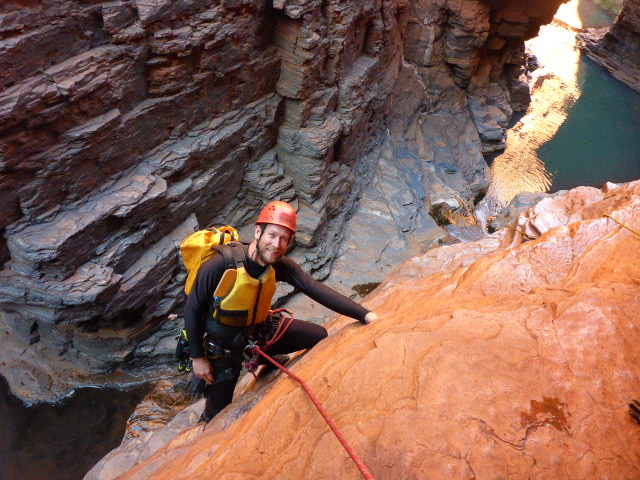

The canyoning brought together a lot of firsts for Estelle; first absail (and down a waterfall at that!); first rock climb in the wild; first tubing; and first traversing a rock ledge using a rope. She did really well at it all. Another thing which is apparently quite common with canyoning is taking photos where you don’t smile and either look very serious or strike some sort of reasonably serious pose. That being the case, the guides always insisted on taking two photos; one with a smile for Mum, and another ‘canyoning’ pose. This did make the day more fun, and made for some great photos.
At this point we had decided that Karijini is an awesome place, and that we’d stay another night so as to be able to explore another one of the gorges. The gorge this time was Joffre’s Gorge. The climb down to the bottom of the gorge was short and steep. As we climbed down the steep, and in some places almost vertical rock ledges, we worked out why this is statistically the most likely place you will hurt yourself in the National Park and need rescuing by the state emergency service. At the bottom of the gorge is another beautiful pool being fed by a cascading waterfall at the start of the gorge, this is where most people end their walk with a swim, then climb back up the wall. We however had been told by our guide the previous day that if you go the other way down the gorge there is what they call the Olympic swimming pool, a deep, 300m long pool which winds its way along till it ends in an island and another waterfall.
We donned our thermal diving vests and headed down a 4m waterfall to the pool, finding a small snake at the bottom. Incidentally, this was the first snake we had seen on the trip, so we moved very slowly past it and began our swim in the frigid waters below. By the end of it we were quite cold, and very thankful for the thermal tops, but even more thankful for the large flat iron-rich rocks on the island which had been sitting in the sun for a number of hours. We spread ourselves out onto a rock each and soaked up the heat from it for a while. After an explore of the island we headed back to the water for the swim home, but this time for some reason we didn’t get cold this time.


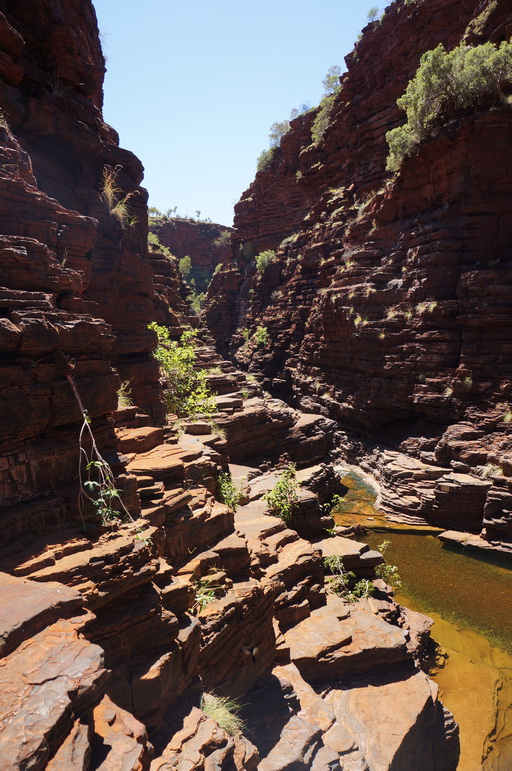
I’m going to skip ahead a couple of days as there was one gorge which was at the complete opposite end of the park, we saw it when we headed from Tom Price to Karratha, but it makes more sense to include it here. Hamersley Gorge in the north west of the park displays some of the most folded rock I’ve ever seen. The hundreds of layers of banded sedimentary rock wave their way up the walls of the canyon in some places completely folding over onto itself. It is really quite an impressive image standing at the base of a wall like this and seeing the incredible forces which must have been required to take nice flat layers and bend them.
We thoroughly enjoyed our time in Karijini national park, and it felt strangely hard to leave the place. We felt like there was still so much more to see and experience there, but we must move on; off to Karratha!
M