Kununurra – Bungle Bungles – Wolf Creek – Lake Argyle
9 – 15 September
With the Gibb River Road behind us it was time to finish off our WA tour with some highlights of the East Kimberly. First stop Kununurra where we were able to pick up a new replacement tyre and bushes for the rear suspension. It is really heating up with the weeks forecast for Kununurra essentially 25-38 deg C for the week, and boy were we feeling it. We hunted out a yummy mango smoothie in an air-conditioned café as a small respite. A restock at the supermarket and we were off down National Highway 1 to a Road Side stop for the night.
It can be a bit tricky to find a spot where we can undertake repairs on the car with most caravan parks not taking too kindly to jacking your car up and crawling underneath with tools and grease, so the nice hard surface at the road side stop provided a great spot for Marcel to replace the rear bushes. To get ahead of the heat we were up before the sun with the car all jacked up and Marcel cracking into the job as the sun poked over the horizon. Even so by the time Marcel was finished both sides 5 hrs later we were both roasty toasty, and I had only been sitting in the shade getting a couple of blog posts up!
All sorted we hit the road south to Purnululu NP and the Bungle Bungle Range. The road into the park was interesting to say the least as it wound around hillocks and roller-coastered up and down across creek beds and over crests. It was a fun 53km drive into the Visitor Centre, and a good test for the refurbished suspension.


That night just as we were ready to head to bed pretty tired from being up early we had what has since been dubbed ‘the ant fiasco’. We had picked up a mob of ants from when we were detained at Windjana Gorge, and whilst doing our best to eradicate them we discovered to our horror that they had chanced upon some celery in the drawer (fridge overflow as we had run out of room). The ants had decided that this was perfect conditions to set up base camp whilst breeding a future army to invade the rest of the vehicle. Ant babies littered the drawer and a sustained clean-up was required. To our relief no more signs of ant babies in the morning, but bug spray was promptly added to the next shopping list.
Another early start as we explored the walks in the northern part of the park. We ended up completing three walks, first up ‘Mini Palms’ that led into a gorge with palm trees unique to the area a relic from when it was a lot wetter, the end of the trail led to a platform looking into where the gorge narrowed into a crack, or as the walk notes stated ‘an amphitheatre of mystery’. To fill in a bit of time we completed the 4km Homestead walk, before it was time for the star of the park on the north side – Echidna Chasm.
Echidna Chasm is a thin chasm with shear sides rising 200m up from the narrow walkway along the bottom, in some parts you could easily touch both walls as once. The walk went right to the end of the chasm and it was fun playing with echoes along the way. Then it was show time – around midday the sun shines down into the chasm lighting it up and making it glow. We weren’t in any hurry so waited as the sun crept down one wall, across the bottom and up the other side as we waited for the effect that is captured on postcards. It had been nice and cool in the chasm, and coming out we were hit with the full heat of the day. After setting up at the campsite at the southern end of the park we did our best to survive the heat – quick nap, reading and Marcel whipped up a batch of brownies to keep us energised. Yummo.
Day two at the Bungle Bungles and we headed for the Domes – orange and black stripped beehive (cone karst) formations that the park is famous for. The black stripes are formed by cyanobacteria that grow on the more porous moisture accumulating layers of rock, whilst the orange bands are due to the oxidised iron in the sedimentary sandstone. It really was an impressive sight, and in a nod to how out of the way they were, it wasn’t until the late 70s when they featured in a documentary ‘WA from the air’ that anyone paid them any attention. Now the park is a World Heritage Site as a premier example of karst sandstone formations in the world.
We went for a walk up Whip Snake Gorge which followed Piccaninny Creek before cutting up the gorge into the heart of the rocks. The Whirlpool holes and grooves running through Piccaninny Creek cut by the flow of water in the wet were really sculptural and show just how strong the forces of water can be. On the way back we stopped in at Cathedral Gorge another highlight of the park. Here a waterfall has undercut the rocks creating a large dome like amphitheatre – very impressive.


On our way out of the park we crossed a couple of young guys on their way back in. We had been crossing paths with these guys since the middle of the Gibb River Road and had seen them when we first pulled up at the Visitor Centre in the park. One of their vehicles had a seized wheel bearing and they had a 1200km return trip to Derby to pick up a new hub. We felt so bad for them, especially when they were already on a tight timeframe for their trip back to Perth. Fingers crossed nothing as dramatic happens to our old girl.
From the Bungle Bungles we decided to head south to check out Wolf Creek Crater, only another 108kms down the main highway then 130kms along the start of the Tanami track – just a short detour. As Marcel said to one guy – we’ve driven further for less. Actually on reflection, it was probably our longest detour so far.
It was nice driving along the Tanami watching as the trees thinned out and you were into open spinifex and scrub plains. Driving late in the afternoon we watched the dusk colours developing, pulling into the campsite just as the sun was setting. Sitting by the fire that night we both commented on how nice it was to be back under a big clear sky in the open plains on the edge of the desert – there was something hard to describe that we both felt, although it was common for early explorers to find an attraction to this desert outback. Might also have something to do with what a great trip we had going ‘up the centre’ five years ago.
The next morning we went and had a look at the crater we had travelled all this way to see. Wolf Creek Crater was formed by an iron meteorite 300,000 years ago. They estimate that the meteorite weighted approximately 50,000 tonnes and was travelling at 15 km/s. The resulting crater is 850m in diameter with the bottom now filled in with sand and some 20m below the surrounding plains. It was interesting looking around the rim at such a round form; it did feel like something a bit different had caused it. And for all those horror film fans, yes we did survive our night at Wolf Creek …
Originally we’d thought we’d continue down the Tanami track into Alice Springs and the Red Centre, but when we stopped to count the weeks left in the year, and the distances we still needed to travel we had a reality check and worked out it wasn’t practical. Whilst being the sensible thing to do with the decision clear in our heads, each of us still had a bit of our hearts sad not to be heading further down the track into the desert.
So we duly headed north back along the way we had come, going all the way up to Wyndham to catch the sunset at the Five Rivers lookout. From the lookout you could see where the five great rivers of the eastern Kimberly (Pentecost, Durrack, King, Ord and Forrest) all made their way to the sea and joined the Cambridge Gulf. Whilst being quite hazy with gusty winds kicking up dust in the air, it was neat to see the coast and get a sense of how large the river systems are.
Continuing the theme of water, it was time to head south east and check out Lake Argyle. The Ord River was dammed in the 1970s to form Lake Argyle, the largest single manmade reservoir in Australia – the equivalent of 17 Sydney Harbours at operating volume and is technically classified as an Inland Sea as in the centre you are more than 3 nautical miles from any land. The water is used as part of a large (currently expanding) irrigation scheme in the fertile lower planes of the Ord River.


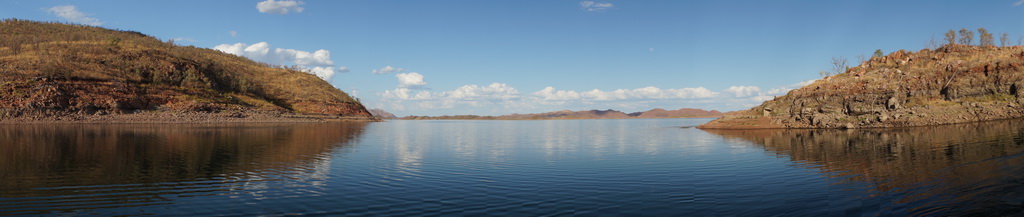


We drove around some of this irrigated land just outside of Kununurra before heading to Lake Argyle itself. In our pattern of making the most of the facilities when we’ve paid for a caravan park we had a bunch of chores to complete – two loads of very dusty washing, cleaning out the freezer and giving the car a wash. Good thing that there was an infinity pool to cool off in afterwards.
That evening we splurged and shouted ourselves to a three hour sunset cruise on the Lake. What a fantastic time. The cruise let us get an appreciation for the scale of the lake, as well as hearing some of the history of the area, enjoying the reflections of the islands, and seeing some of the local wildlife – a few of the 30,000 fresh water crocs who live in it and we were also lucky to see a graceful Jabiru (a large stork) in flight. But the highlight was at sunset itself were everyone promptly hopped in for a swim in the lake complete with pool noodle and a cool beverage or two. We felt like kids again as we floated watching the colours change, catching another beer thrown from the boat and nibbling on a cheese board nestled in the middle of a life ring.
And so we wrap up our time in WA – 83 days (12 weeks) and some 14,000kms later it is time to head east into the Northern Territory. We have really enjoyed WA, it really is a huge state with such a variety of landscapes, wildlife and weather. But now it’s onto our next adventure in the Top End.
E